
You’ve probably seen the word ATP thrown around in every supplement description on the market. Fewer people can actually explain what it means, or why a molecule you can’t see or feel determines whether you power through a hard set or hit a wall halfway through.
ATP is the energy currency your cells spend to do anything at all: contract a muscle, fire a neuron, keep a heartbeat going. The catch is that your cells can’t store much of it. At any given moment, you’re only holding a few seconds’ worth of ATP in reserve. So the real question isn’t «how much ATP do you have?» It’s «how fast can your cells make more of it?»
That’s where the creatine kinase/phosphocreatine system, or CK/PCr system, comes in.
The fastest recharge mechanism your cells have
When ATP gets used, it loses a phosphate group and becomes ADP. To keep working, that ADP needs its phosphate back, and fast. The CK/PCr system solves this through a simple, elegant reaction: the enzyme creatine kinase transfers a phosphate group directly from phosphocreatine to ADP, regenerating ATP almost instantly.
No multi-step metabolic pathway. No waiting on oxygen delivery. Just a direct, on-demand phosphate handoff.
This is why the CK/PCr system is often described as the body’s fastest energy buffer, it’s the first line of response whenever energy demand spikes suddenly, before slower systems like glycolysis or oxidative phosphorylation even have time to ramp up.
Why this system exists wherever demand is highest
The CK/PCr system isn’t unique to muscle. Creatine kinase and phosphocreatine are present in any tissue that experiences rapid, fluctuating energy demand, skeletal muscle being the most studied example, but also tissue types where energy supply and demand can shift from one moment to the next.
The common thread is simple: wherever ATP demand can spike quickly, you’ll find this system standing by to meet it.
Two components, two different jobs
It helps to think of the system as having two separate roles:
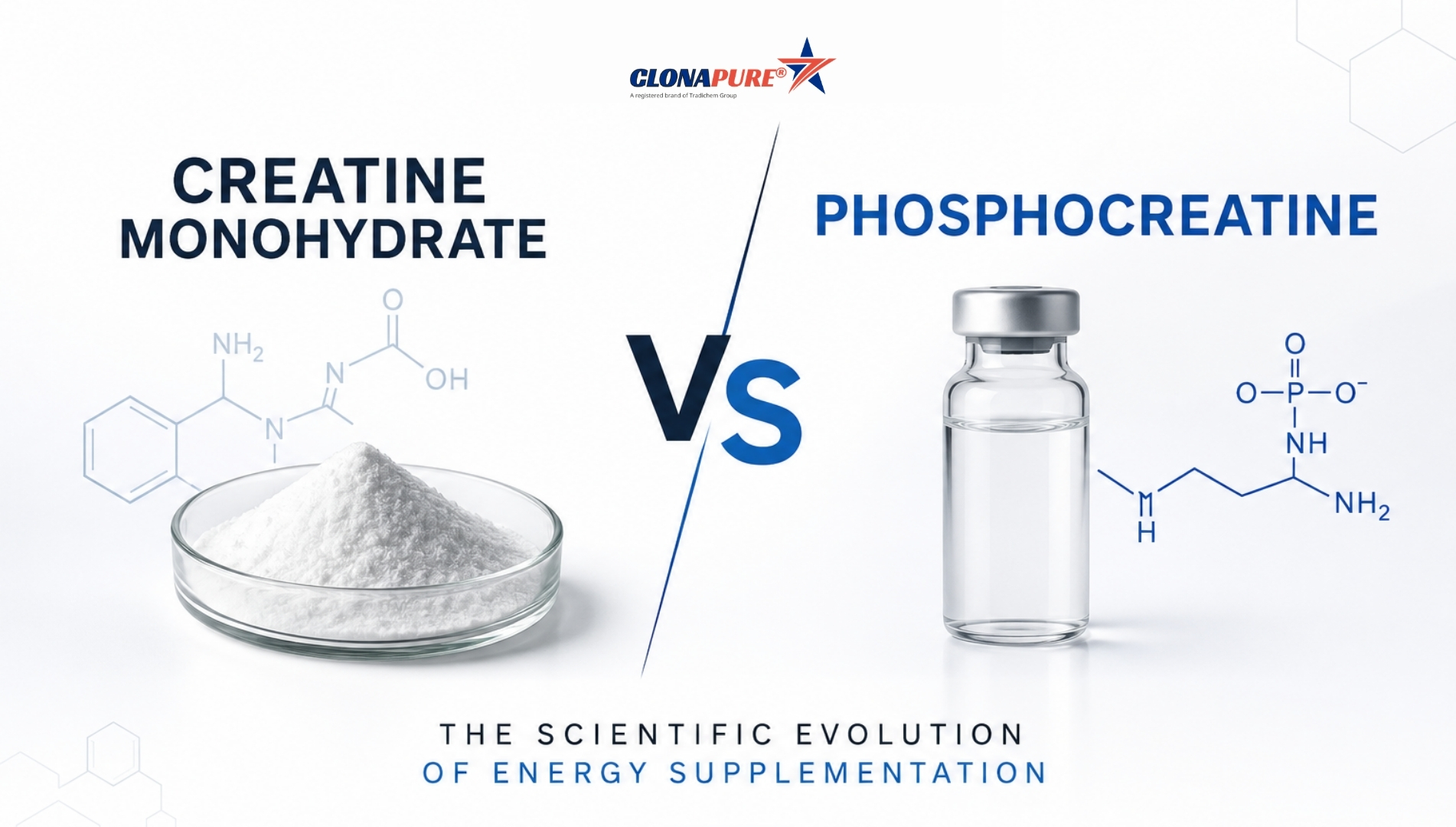
- Creatine monohydrate builds and maintains the reserve; it’s the pool your cells draw from over time.
- Phosphocreatine is the active, ready-to-use form; it donates its phosphate group immediately, without needing to be converted first.
Most conventional creatine supplementation relies entirely on the first part of this equation, creatine monohydrate, and depends on your body’s own metabolism to convert a portion of it into phosphocreatine as needed. That conversion step takes time, and typically explains why loading protocols exist in the first place: to build up a large enough reserve before the active form becomes available in sufficient quantity.
The Clonapure approach: built around the system itself, not just one part of it
This is the exact logic behind Clonapure‘s formulation. Rather than supplying only the reserve-building component and waiting on your body to do the conversion, Clonapure already contains bioavailable phosphocreatine alongside creatine monohydrate, engineered specifically around how the CK/PCr system actually operates.
Practically, this is reflected in the format itself: 3g a day, with no loading phase required, because the active donor is already part of the formula rather than something your body has to build up to over one to two weeks.
What this means for performance
Creatine’s role here isn’t theoretical. It’s one of the most established claims in sports nutrition: creatine supplementation increases physical performance during successive bursts of short-term, high-intensity exercise, at a daily intake of 3g. That claim exists precisely because of the mechanism above: the faster your cells can regenerate ATP via the CK/PCr system, the better they can sustain repeated, high-demand effort.
Understanding the system doesn’t just satisfy curiosity. It explains why formulation choices, monohydrate alone versus a complex built around the full pathway, aren’t a marketing detail. They’re the difference between supplying raw material and supplying a system.